MBDA LCM Mk2: New 1,000+ km Cruise Missile Unveiled at Eurosatory 2026
Transcript
Machine-transcribed by YouTube. Expect errors in names, commands and version numbers.
Hi, right. You're at Eurosatory 2026 in Paris, France. We're now on the large booth of MBDA, Europe's leading missile manufacturer. They are debuting the new
LCM and MDCN Mark 2. It is an evolution
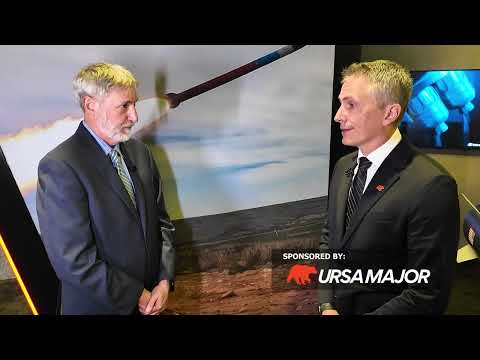
of the in-service naval cruise missile and we're going to find out all about it with Paul Woer. Product line owner for deep strike weapons at MBDA.
>> [music]
[music] >> Paul, good morning. Good to see you again. >> Welcome to MBDA. >> Thank you for welcoming us. Wow, I'm really impressed by this this news this product launch at Eurosatory this year. So, a new LCM and NCM.
It's main feature that I can't help but notice it there's a new front end for the missile. My first question is why? What does it bring? >> So, thank you Xavier. Indeed, we are very excited here to present the new naval cruise missile and land cruise missile. One missile for two applications. Land applications and naval applications. We also excited to bring for the first time the ground launch system for the LCM at scale. And also a very interesting demonstration on how we use AI to tackle targets on the battlefield very fast.
If we talk about the missile itself, it is going to be a new generation, basically. We have a new front hand, so it's going to be more survivable, more discreet, more stealth on the battlefield. Also, it has a new anti-jamming feature, so more robust. We are strengthening its robustness against GPS denied capability. Also, more range and more lethality. So, the whole new deal. >> So, that's wow, that's quite a lot and a big increase in capability like across
the across the board. I believe the production line for NCM ended in 2021, 2022. Are you looking forward to restarting production with the Mark 2? >> So indeed, today we are working with DJ to have the new contract to develop and produce the Mark 2. It will be ready as of 2030. >> And what about naval application? >> So indeed, so the missile will be used from frigates, from submarines, even deep into the sea. And this is the only missile where you can strike beyond 1,000 km from the land or from the sea. >> Lastly, regarding the the the Mark 2, why did you bring these evolutions, improvements? Is that from feedback
from the French Navy? >> Well, it's a feedback from everyone basically. We have 90 customers worldwide. They are using our products and giving giving us feedback to feed our product road maps. This is how we can we are able to improve our products to meet the new threats. >> All right, Paul. Well, there's this massive LCM launcher in a one-to-one scale right in front of us. May we please take a step to get closer and take a closer look? >> Let's go see it, right? >> Wow, Paul, this launcher is really impressive. What can you tell us about it? >> Yeah, it's quite the beast, right? Well, what we can tell you is that we are currently developing the system to respond to the requirement for the European forces that are interested to have a mobile platform. Today, we really want to protect the mobility of the platform. So the LCM will be able to deploy within 15 minutes to fire and then decamp within 15 minutes as well to avoid any enemy counter battery.
>> Well, so yeah, such mobility I think that's a key strength compared to existing systems out there such as the Typhoon which I believe requires a lot of logistics. Well, that that was a key driver for LCM. >> Yeah, we have taken a different philosophy. It's a bespoke launcher, but we are reusing the electronics from the naval one. They are to be faster to the market. LCM is all about reuse, reusing what exists from NCM program, naval cruise missile, which is combat proven and meeting the requirement of French Navy to bring it rapidly to the market for ground-to-ground strike. >> And the whole system, so the the truck, the trailer, it's quite a light system. It can use any kind of roads in Europe. It can can it go off-road a little bit?
>> Basically, any road anywhere will be able to fire the LCM.
>> And you mentioned that European requirement or European need, is that in the frame of ELSA? >> So, ELSA is a firm where countries are discussing requirements. We have presented LCM as a solution, as an alternative sovereign alternative to other solutions on the market and also the quickest one when you want to build up your forces for 2030. >> Okay, and lastly, Paul, so as MBDA is getting uh ready with the French defense procurement agency DGA to restart production, are you anticipating larger production volumes or will you be able to produce at scale to answer that potential European demand? >> I think currently MBDA is changing. We are investing 5 billion euros between 2016 and 2030 to ramp up production.
We are hiring more than 200 people, 2,500 people a year. So, we are really changing to meet up this requirement and be able to produce as fast as we can for the European forces. >> All right. Well, you showed us the new LCM NCM Mark 2. You showed us for the first time this LCM launcher. What about typical scenario for LCM and
NCM use? Can you please show us some scenarios? >> Yes, we can do that right now with our demonstration where we use AI to go really fast to the target. >> We now stepped into a room to see some demonstration scenarios of LCM engagements. Paul, what can you tell us about the scenario you're demonstrating to us? >> So here I'm going to show you how we are going to architecture the LCM battery first. So here we can see the different ground base launching units on the theater equipped with four missiles each able to fire the new NCM LCM Mark 2 missile. So again, with the all the new features we are bringing to to the capability. And here we have the command control post on the battlefield.
And with AI, we are able to attack rapidly time sensitive targets because we will generate trajectories very fast. And these trajectories can be combined with one way vectors called deluge, the new low cost saturation weapon that we are developing for France. >> MBDA provides the command and control system for land applications for the LCM. >> So today here we are providing the turnkey solution using our own capability to for the customers to have everything in its hands from MBDA. Of course, we are open to cooperation. The whole LCM is open to cooperation with the European partners. >> And using AI to help the operator identify the best trajectories and angle of attacks and avoid enemy air defense.
Is that a factor in the ability of the LCM to basically shoot and scoot, basically get in position and in 15 minutes launch the LCM and then get out? >> Absolutely. We are fast tracking everything. So tomorrow the ground forces will be able to fire quickly the LCM with base on the trajectory that will also have been generated quickly through AI. The the whole thing is getting fast-tracked. >> Very well, Paul. Thank you very much. >> Thank you.